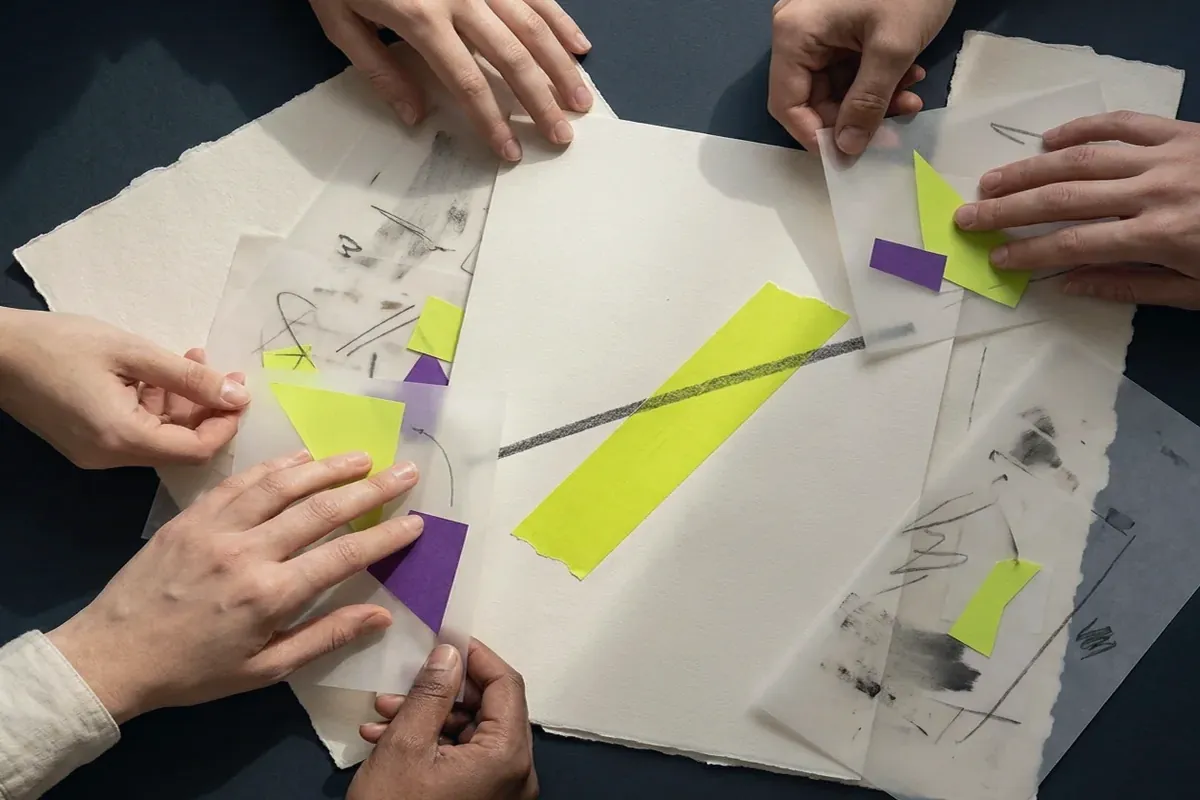
Collaboration improves a long piece when everyone knows which decision they own and which pass they are working in. Without that, a draft collects preferences instead of edits and the writer becomes a referee. A workable editing workflow assigns decisions, sequences the revision, and turns each round of comments into an ordered plan.
- Name the draft's biggest problem before you decide who reviews it.
- Give every editorial decision exactly one accountable owner.
- Run developmental, section, line, and proof passes in that order.
- Group comments into a written revision plan before rewriting anything.
- Close each round with a summary of accepted, declined, and deferred changes.
Diagnose the draft before you invite readers
Read the whole draft once and name its largest problem. A draft with the wrong argument does not need a line editor. A draft with a sound argument and a slow middle does not need three subject experts. The diagnosis decides who you invite.
Write that diagnosis at the top of the document in one or two sentences. It sets the terms of the round. Reviewers who know the piece is still structurally unsettled will not spend their attention rewriting sentences that may not survive the week.
Assign roles by the decision each person owns
The writer owns coherence and intent. The structural editor owns whether the argument arrives in a usable order. The subject expert owns accuracy inside their domain. The approver owns risk. One person can hold several roles, but each decision needs exactly one accountable owner.
Name the owners in the document rather than in a message that scrolls away. When a comment falls outside a reviewer's role, it becomes a suggestion instead of a requirement. That distinction settles most review-round arguments before anyone has to have them aloud.
A comment is not an edit until someone decides what it changes.
Agree the structure before anyone edits prose
Circulate a reverse outline before the full draft. A reverse outline states, in one sentence each, what the existing sections actually do rather than what they were meant to do. It exposes repetition, missing steps, and sections that exist because they were easy to write.
Structural disagreement is far cheaper to resolve at outline length. Two people can settle a chapter order in ten minutes while it is still a list. The same disagreement raised against a polished draft costs a week of rewriting and damages somebody's best paragraphs.
Sequence the revision passes
Run the developmental pass first: purpose, claim, evidence, order, and anything the piece promises but never delivers. Then the section pass, which asks whether each section does one job and hands off cleanly. Then line editing for rhythm and precision. Then copy and proof.
The order matters because each pass costs more than the one before it and hurts more to redo. Careful sentence work on a section you later cut is the most expensive waste in the project. Declare which pass a round is, and hold reviewers to it.
Turn comments into a revision plan
Do not revise comment by comment. Read them all first, then sort them into three piles: several notes describing one underlying problem, requests that genuinely conflict, and noise. Most rounds contain fewer real problems than comments, and the grouping is what reveals that.
Write the plan as a short ordered list of changes with the sections each one touches. Share it before you start rewriting. Reviewers get to confirm you understood them, and you get one chance to catch a change that would break something they cared about.
Protect the writer's intent
A collaborative edit can smooth a draft into something nobody objects to and nobody remembers. Keep a one-line statement of intent at the top of the document: what this piece argues, and who it is for. Test proposed changes against that line.
When a reviewer rewrites a passage in place, ask what problem the rewrite solves. Accept the diagnosis more readily than the prose. The reviewer holds the standard and the writer holds the voice, and a draft that loses its voice loses the reason to finish it.
Close the round and record what changed
End every round explicitly. Resolve the threads, then publish a short summary: what you changed, what you declined and why, and what is deferred to a later pass. An open thread from three weeks ago is a permanent tax on everyone who opens the file.
The summary protects the next round as well. Reviewers who see that a suggestion was considered and declined rarely raise it twice, and someone joining late can tell which questions are already settled instead of reopening them with fresh enthusiasm.
A reverse outline that found the real problem
Reverse outline of a 6,000-word report draft, one line per section as written: 1. Why the old process was painful. 2. History of the team and how it grew. 3. Why the old process was painful, with numbers. 4. What we changed, in the order we changed it. 5. A vendor comparison from the original evaluation. 6. What we changed, seen from the customer's side. 7. Problems we hit during the rollout. 8. Why the old process was painful, restated as a lesson. 9. What we would do differently.
Revised section plan after the structural round: 1. The decision the reader faces, and what this report settles. 2. Why the old process was painful, using the numbers from old section 3. 3. What we changed, told once, with the customer view folded in. 4. What went wrong during the rollout, and what it cost. 5. What we would choose differently next time. Old sections 2 and 5 moved to the cut file. The lesson from old section 8 became one sentence.
Three of the nine original sections made the same point at different lengths, which nobody noticed while reading top to bottom. The reverse outline made the repetition visible in under a page, and the fix was a reordering rather than a rewrite.
Common mistakes
| The mistake | Why it costs you, and what to do instead |
|---|---|
| Line editing a draft that is still moving | Reviewers polish sentences because sentences are easy to comment on. The structure then shifts and the careful work disappears. State which pass the round is, and ask reviewers to hold surface notes until the argument settles. |
| Inviting reviewers who own no decision | Adding readers feels inclusive until the comments arrive. Each extra reviewer without a defined role contributes preference rather than information. Invite those who own accuracy, structure, or risk, and give everyone else a read-only link. |
| Averaging conflicting feedback | Two reviewers want opposite things, so the writer splits the difference and satisfies neither. Take the conflict back to the stated intent and the decision owner. One of the two is usually outside its author's role. |
| Leaving comment threads open forever | Threads accumulate because closing one feels like a decision nobody wants to make. Old threads then bury new ones. Close each thread when the round ends, marking it changed, declined with a reason, or deferred. |
Your checklist
- Read the full draft once and write the diagnosis in one sentence.
- List each reviewer beside the decision they own.
- Circulate a reverse outline before you circulate prose.
- Declare which revision pass this round is.
- Group the comments into an ordered revision plan and share it.
- Post a round summary listing accepted, declined, and deferred changes.
Key terms
- Developmental pass
- The first revision pass, which examines purpose, claim, evidence, and the order of sections rather than sentences. It decides what belongs in the piece and what the piece must prove.
- Decision owner
- The single person accountable for one kind of editorial call, such as structure, accuracy, or risk. Others may comment on that call, but only the owner settles it.
- Round summary
- A short note published when a review round closes, listing what changed, what was declined and for what reason, and what was deliberately deferred to a later pass.
Getting a draft read by someone else?
Frequently asked questions
How many reviewers should a long draft have?
+
Count distinct decisions rather than people. Most long pieces need one structural editor, one subject expert for each unfamiliar domain, and one approver. Beyond that, extra readers contribute preference. Give interested colleagues a read-only link so they can follow without commenting.
Should reviewers edit the draft directly?
+
Typos and factual corrections are fine to fix in place. Anything that changes an argument, a section's job, or the voice belongs in a comment with a reason. Direct rewrites hide the diagnosis and take away the writer's chance to solve it their own way.
What exactly is a reverse outline?
+
A reverse outline is a one-sentence description of what each existing section actually does, written after the draft exists rather than before. Because it describes the real shape of the piece instead of the intended one, it exposes repetition and gaps that reading straight through hides.
Can Strut AI help with a structural edit?
+
Strut AI handles the mechanical parts of a structural edit quickly: producing a reverse outline, listing claims that appear without support, or flagging two sections that make the same point. Treat that as a faster diagnosis. Deciding which section carries your argument better is still the writer's call.
What if a reviewer misses the window?
+
Publish the round summary on schedule and log their comments as input to the next pass. A round that waits for everyone becomes a round that never closes. Reserve the right to block a close for the approver and for whoever owns accuracy.
When is structural editing finished?
+
When every section does one job, the order follows the reader's questions, and no reviewer with a structural role has an open objection. Once that is true, move to line editing and stop reopening the outline. Late structural changes invalidate the sentence work below them.